
Slow social media: a town with no feed
What slow social media means, where the idea comes from, and how CozyWeb does it with a tiny house on the internet, letters that take days and no feed.
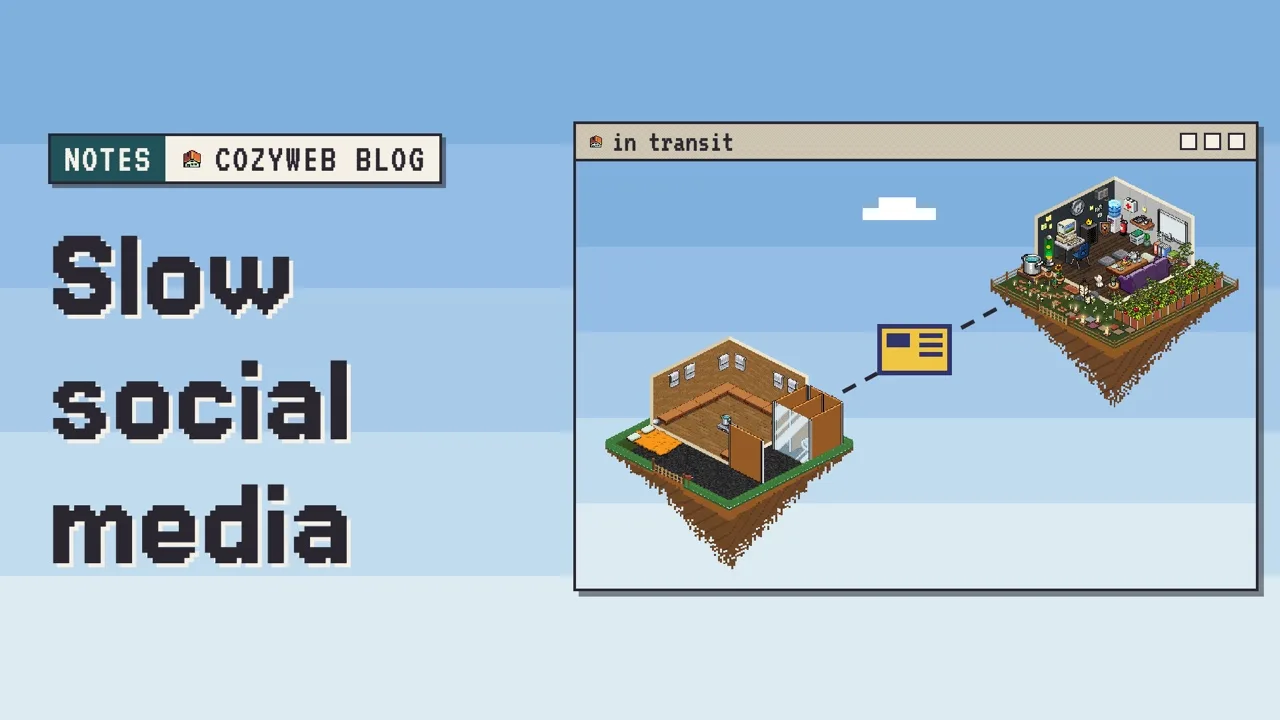
Slow social media is social media that takes its time. It has no endless feed, no algorithm that picks what you see and no numbers to chase. You see what the people you know made, and then it ends.
CozyWeb is a small, slow social website, built as a town. You live in a tiny house on the internet, and a letter to a friend can take days.
What is slow social media?
The idea is older than it looks. In 2010, three authors in Germany, Benedikt Köhler, Sabria David and Jörg Blumtritt, published The Slow Media Manifesto. Point 7 says "Slow Media are Social Media". Point 9 says slow media spread by recommendation, not by advertising.
In September 2025, Herman, who makes the blog platform Bear, wrote a post called Slow social media. He listed what a slow network would have:
- Friends, not followers. Both people have to agree.
- A limit of about 300 friends.
- A feed in the order of time, with a natural end.
- Pages, not an endless scroll.
- No recommendations, no ads and no short videos.
So slow social media is not one app. It is a set of choices. Something ends. You pick the people. And nobody earns money from your attention.
Is slow social media the same as anti social media?
Almost. "Anti social media" is the wider name.
People use it for any social app that is built against the habits of the big networks. In March 2026, the newsletter Fitt Insider wrote about a wave of them in Anti-Social Media Apps Arrive, and described them as "Intentionally nonaddictive, new social platforms".
Slow social media is one kind of anti social media. It does not only take the ads out. It changes the speed.
Why do people want slow social media?
Because the fast kind stopped being about friends.
Herman's post says it plainly. The big networks turned into "advertisement-funded content mills which are explicitly designed and continually refined to keep you engaged".
Three essays sit on the shelf in my About notice, because they shaped the town: "Are You Experiencing Posting Ennui?" by Kyle Chayka, "Too Big to Care: Enshittification Is a Choice" by Cory Doctorow, and "Stop Talking to Each Other and Start Buying Things" by Catherynne M. Valente. All three are about what went wrong with the big platforms.
How does CozyWeb do slow social media?
CozyWeb went one step past a slower feed. It has no feed at all. It has houses.
- Letters take real time. A letter travels the real distance between you and your friend, at about 300 kilometers an hour. Inside one country it arrives in an hour. To the other side of the world it takes two or three days.
- There are no likes, so nobody keeps score. A visitor signs your guestbook with words.
- Nothing is ranked, and nothing is pushed at you.
- The town paper, the Gazette, prints an edition when you open it. You read it, and it ends.
- There are no ads, and no investors to please.
Why a tiny house on the internet?
Because a house is not a profile.
A profile is a page that feeds a feed. A house is a place. You decorate it, you fill the yard, and you pin notes to your things. Then a neighbor walks in, looks around and signs the guestbook.
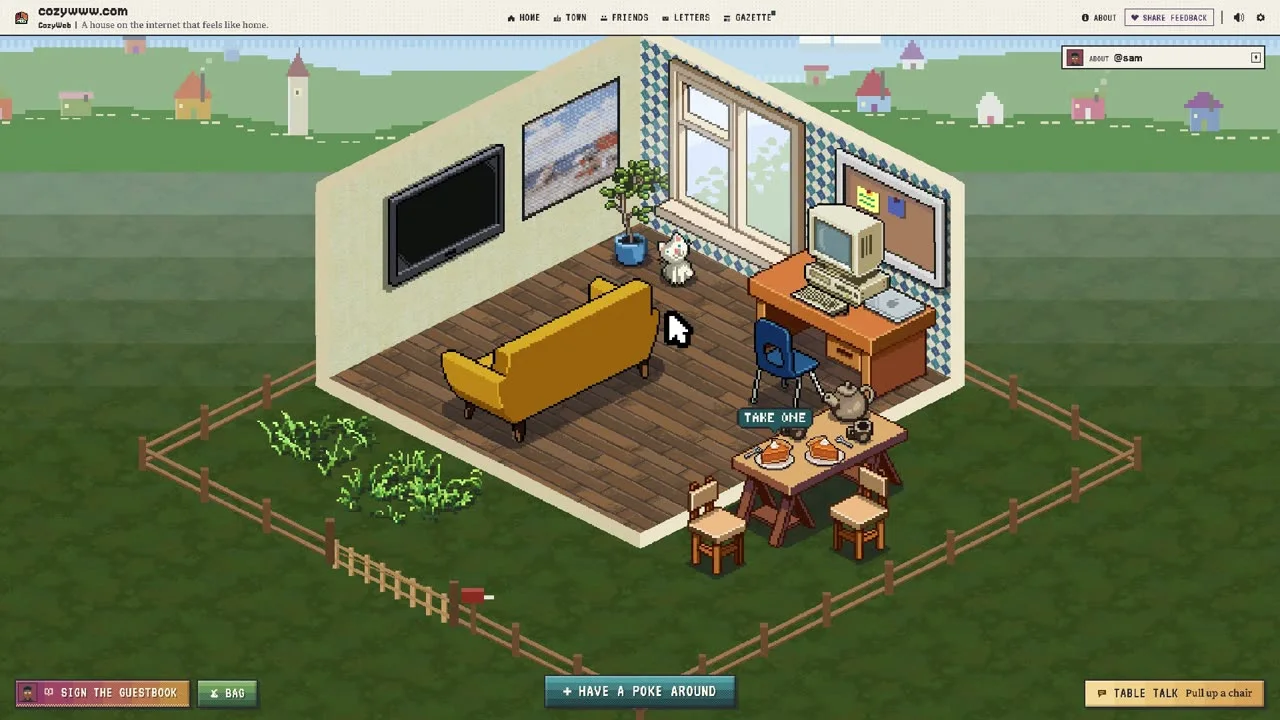
You do not scroll past a house. You visit it. That is the whole trick, and it is why a tiny house on the internet feels slower than any timeline.
Every house has its own address, like cozywww.com/farida. You can explore the houses without an account.
Is CozyWeb social media with no algorithm?
Yes. Nothing in the town is sorted by a machine.
You find people on the town map, or by what they love, from books to tabletop games. You see what your neighbors make when you visit them, or when the Gazette prints it.
Who is slow social media not for?
It is not for news, and it is not for a big audience.
If you want to know what happened an hour ago, a slow place is the wrong place. If you want a crowd for every post, the town is not built to give you one.
It is for the other thing: a few people, a letter that is worth the wait, and a place that is still there tomorrow.
Where do I start?
Read what the cozy web is, the idea next door. Take the tour of Sam's house. Or read About CozyWeb for the whole story.
I'm Farida. I build the town on my own, and I'm its Mayor. Come be my neighbor.